01
Normalize the record
Resolve members, roll calls, bill context, and valid vote positions across the session.
A self-directed demonstration of how Polilens can normalize a full legislative vote record, model member-specific baselines, and turn the results into inspectable network views.
Allen Ye
Founder & Software Engineer
87
modeled Republicans
1,586
qualifying divided GOP rolls
1,245
modeled GOP connections
34
cross-party pairs
This demonstration asks which voting relationships exceed what a member's normal behavior and each roll call's difficulty would predict.
01
Resolve members, roll calls, bill context, and valid vote positions across the session.
02
Estimate member- and roll-specific baselines instead of treating every agreement equally.
03
Apply effect-size, uncertainty, multiple-testing, and bootstrap gates to each pair.
04
Open portraits and connections to see the members, direction, and contributing roll calls.
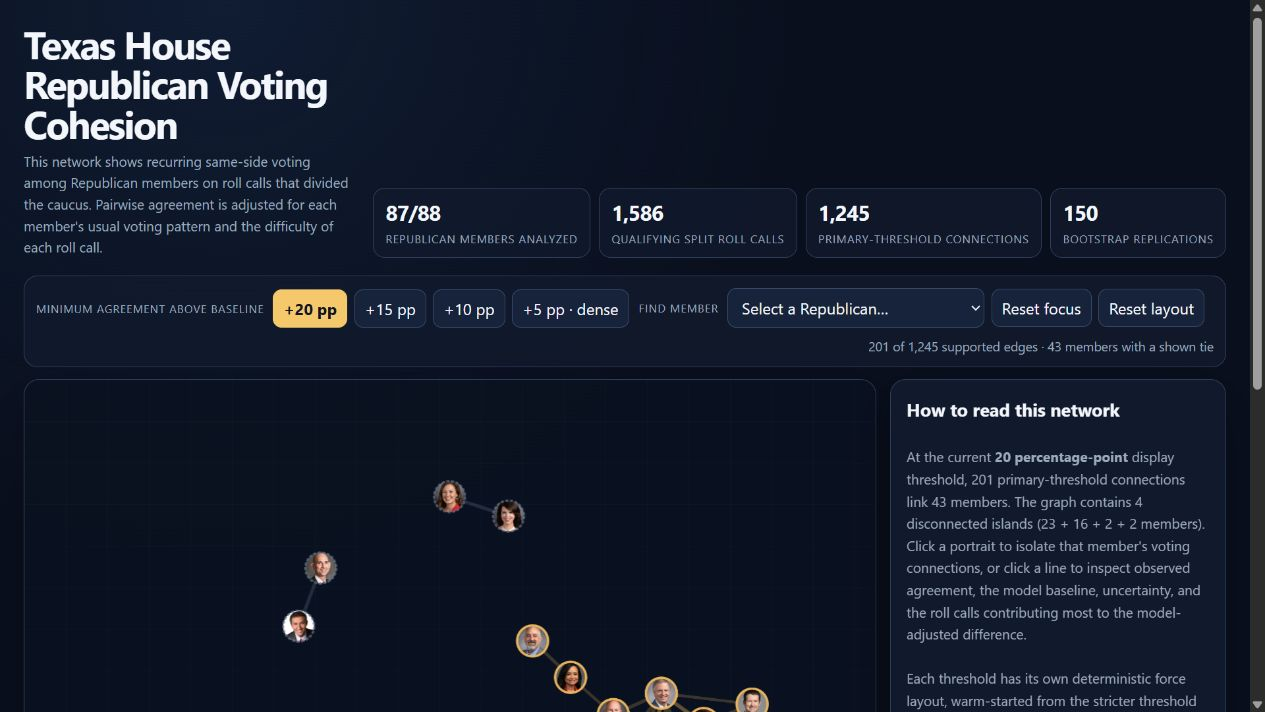
Within-party model
Which Republican pairs vote on the same side more often than member-specific and roll-adjusted baselines predict?
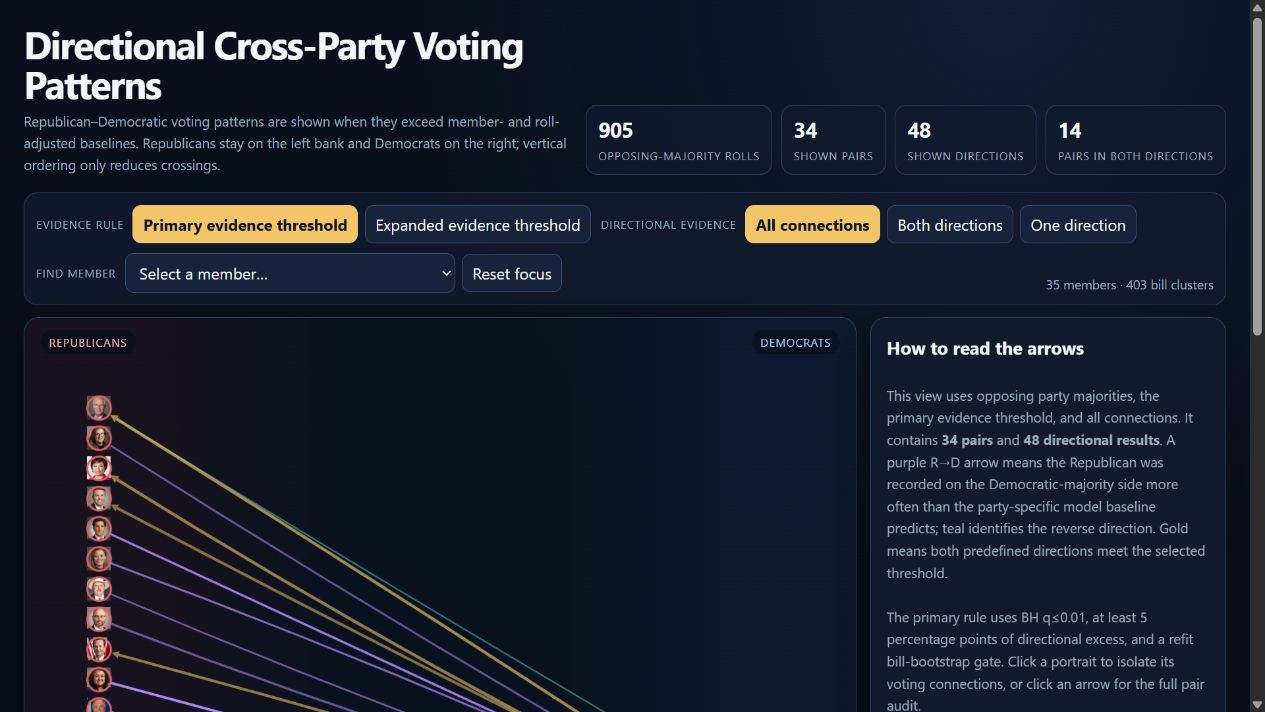
Republican ↔ Democrat
Which Republican and Democratic pairs appear on the other party’s majority side more often than party-specific model baselines predict?
The useful output is not limited to a network. The underlying process supports caucus analysis, issue coalitions, target-member research, vote-context reconstruction, and session-level behavioral briefs.
Legislative member and vote data derived in part from LegiScan datasets, licensed under CC BY 4.0. Polilens transformed the source data and produced the analysis shown here.